Illinois Public Act 104-0090: What the 2026 Allergen Training Law Means for Your Restaurant
Published June 2026 · Compliance Guide for Illinois Public Act 104-0090
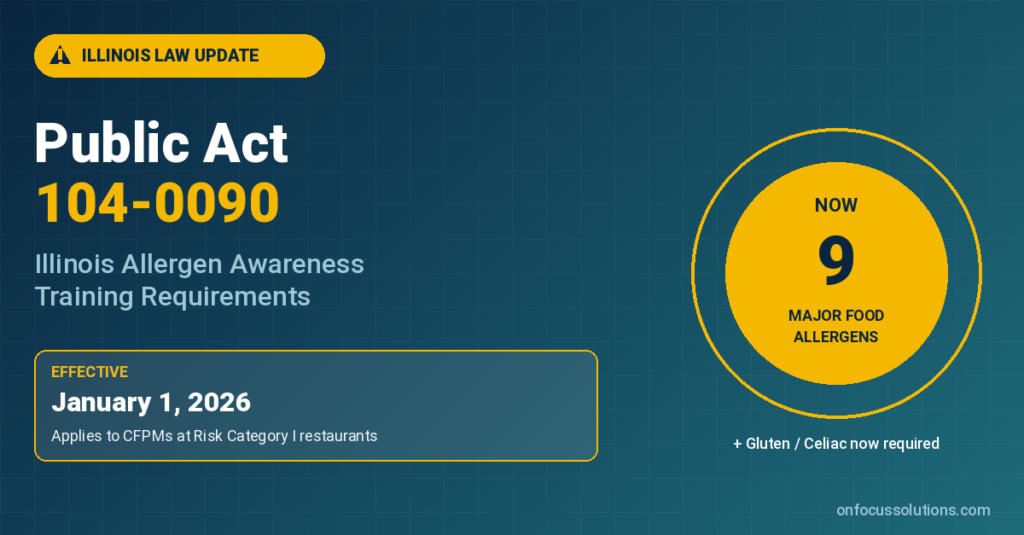
If you operate a restaurant in Illinois, the rules around allergen awareness training changed at the start of 2026 — and many operators are still catching up. Public Act 104-0090, signed into law on August 1, 2025 and effective January 1, 2026, modernizes Section 3.07 of the Food Handling Regulation Enforcement Act and updates what every Certified Food Protection Manager (CFPM) at a Risk Category I restaurant is required to know.
If you’ve heard about the law but aren’t sure what’s actually new, who it applies to, or how to prove compliance to an inspector, this guide breaks down everything you need to know — and how to get your team trained today for $18.95 per person.
At a Glance
What: Illinois Public Act 104-0090 amends Section 3.07 of the Food Handling Regulation Enforcement Act
Effective: January 1, 2026
Who must comply: Certified Food Protection Managers (CFPMs) at Risk Category I restaurants
Renewal: Every 3 years; new hires must complete training within 30 days
Format allowed: Online, classroom, remote, or in-house — no proctor required
What Changed Under Public Act 104-0090
Illinois has required allergen awareness training for restaurant managers since 2018. Public Act 104-0090 doesn’t replace that requirement — it modernizes it. The biggest shifts fall into three categories:
1. Gluten and Celiac Disease Are Now Required Training Topics
Section 3.07(c)(14) — newly added — explicitly requires training to cover gluten and celiac disease as a topic, alongside the existing 13 required topics. This is a significant practical shift because gluten-free guest requests are no longer edge cases. Roughly 1 in 100 Americans has celiac disease, and the broader gluten-free segment has grown to over 30 million people. Cross-contact in a typical kitchen — shared fryers, shared cutting surfaces, flour-dusted prep areas — can cause serious reactions even when an ingredient list looks safe.
2. Sesame Is Officially the 9th Major Food Allergen
Federal law added sesame as the 9th major food allergen in January 2023 through the FASTER Act, but Illinois has now codified it directly into the state’s allergen training requirements. Joining milk, eggs, fish, shellfish, tree nuts, peanuts, wheat, and soybeans, sesame must now be covered in every Illinois-approved allergen awareness course. If your manager’s training certificate predates this change, the curriculum may not include sesame at all.
3. ANSI Accreditation Is Now Required
Allergen training programs must now be accredited by an ANSI-recognized body under standard ASTM E2659-09. This change raises the bar on curriculum quality and assessment integrity. Generic in-house training that hasn’t gone through formal accreditation no longer satisfies the law — even if it covers all the right topics.
Who Must Comply
This is one of the most commonly misunderstood parts of the law. Public Act 104-0090 applies only to Certified Food Protection Managers (CFPMs) at Risk Category I restaurants — not every food handler.
A Risk Category I restaurant, as defined by the Illinois Department of Public Health, is a business primarily engaged in selling ready-to-eat food for immediate consumption. The practical threshold: at least 51% of total sales (excluding liquor) come from ready-to-eat food. Most full-service restaurants, fast-casual concepts, food trucks, catering operations, and quick-service restaurants fall into this category. Convenience stores, retail markets, and some grocery operations typically don’t.
If you run a Risk Category I operation, every CFPM on your team needs to complete an ANSI-accredited allergen awareness course that covers the new gluten/celiac and sesame content. Food handlers without CFPM certification are not required by state law to take the training — though many restaurants train all staff anyway, since servers and line cooks interact with guests and allergen-sensitive orders every shift.
Timing: New Hires, Renewals, and Pre-2026 Certificates
The law spells out three timing scenarios:
- New hires: A CFPM must complete allergen training within 30 days of their hire date.
- Recertification: Certificates are valid for 3 years, after which training must be repeated.
- Pre-2026 certificates: If your manager completed allergen training before January 1, 2026, the certificate remains valid for its full 3-year term. When it expires, the renewal course must include the new gluten/celiac and sesame content required under Section 3.07(c)(14).
In short: nobody has to retake training immediately, but every renewal from this point forward must use a PA 104-0090-compliant course.
Online Training Is Explicitly Allowed
One of the most operator-friendly provisions of the new law is Section 3.07(h), which expressly permits training to be conducted “by any means available, including online, computer, classroom, live trainers, remote trainers, and food service sanitation managers who have successfully completed an approved allergen training.” Crucially, a proctor is not required. CFPMs can complete training on their own schedule, on their own device, from anywhere.
This matters because the practical reality of restaurant staffing is that pulling managers off the floor for classroom sessions is expensive and disruptive. A 1-hour online course completed on a phone during a slow afternoon is far easier to schedule than coordinating a group training day.
Enroll in Illinois Allergen Awareness Training