The “Danger Zone”: Why 41°F–135°F Matters for Foodborne Illness
The danger zone from 41°F to 135°F is the temperature range where harmful bacteria can grow quickly on many foods, which is why the FDA Model Food Code sets strict limits around it. Keeping food out of this range as much as possible is one of the most effective ways to prevent foodborne illness in retail and restaurant settings.[web:2][web:284]
What the Danger Zone Means
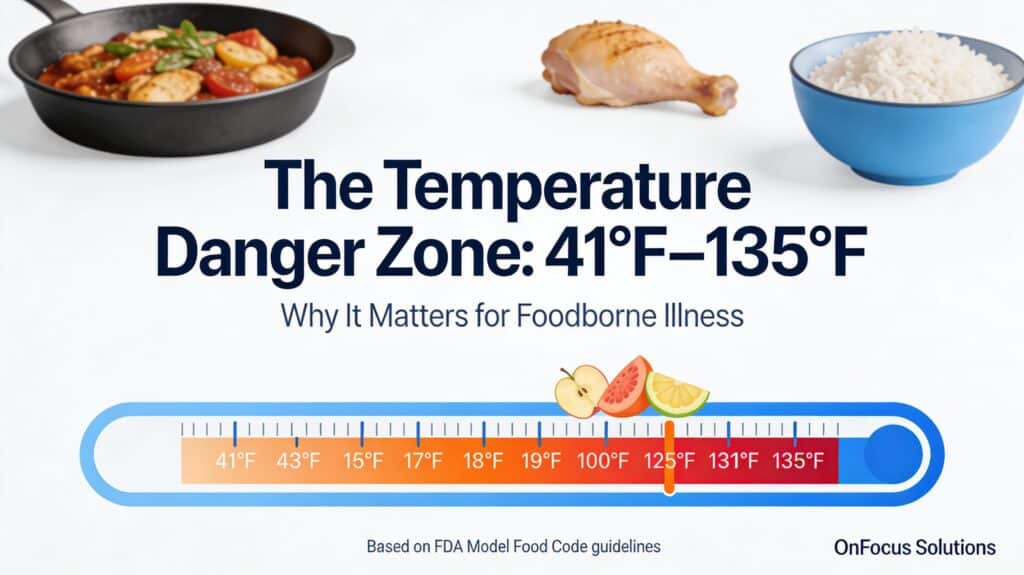
The temperature danger zone is the range between 41°F (5°C) and 135°F (57°C) where many foodborne pathogens can multiply rapidly in Time/Temperature Control for Safety (TCS) foods. These foods include items like cooked meats, poultry, rice, beans, soups, sauces, and cut fruits and vegetables that naturally support bacterial growth.
Within this range, certain bacteria such as Salmonella, E. coli, and Clostridium perfringens can double in number every 20 minutes under the right conditions. The longer food sits in the danger zone, the higher the chance that bacteria will reach levels that can cause illness.
FDA Model Food Code Limits
To control this risk, the FDA Model Food Code sets clear holding temperatures for TCS foods: cold foods must be kept at 41°F or lower, and hot foods at 135°F or higher. Any significant time spent between these temperatures must be tightly controlled during preparation, cooking, cooling, and reheating.
Many state and local food safety guides also stress that food should not remain in the danger zone for more than 4 hours in total before being discarded. This cumulative time includes preparation, cooling at room temperature, and periods on the service line or counter.
Why 41°F Is the Cold Limit
Dropping cold-holding requirements to 41°F or lower makes it harder for many common pathogens to multiply to dangerous levels. Some bacteria can still slowly grow just above refrigeration temperatures, but the growth rate is greatly reduced compared with conditions in the middle of the danger zone.
The Food Code’s cold-holding limit at 41°F replaced older standards such as 45°F because research showed that tighter control is needed to better manage pathogens over typical storage times. By keeping cold food at or below 41°F, operators add an extra layer of safety if food is stored for several days.
Why 135°F Is the Hot-Holding Limit
At the upper end of the danger zone, the Food Code uses 135°F as the minimum hot-holding temperature for TCS foods. Above this point, most foodborne pathogens cannot grow, and at even higher cooking and reheating temperatures they are actively destroyed.
The Code distinguishes between holding and cooking: cooking or reheating must reach higher temperatures—such as 165°F for many TCS foods—to rapidly kill pathogens before food is placed into hot holding at 135°F or higher. Holding food below 135°F for extended periods allows surviving bacteria to grow back, which is why maintaining hot foods at or above this threshold is critical.
Time and Temperature Working Together
Food safety is never about temperature alone—time always matters too. The danger zone is especially risky when food spends multiple hours at mid-range temperatures, roughly between 70°F and 120°F, where many pathogens grow fastest.
For cooling, the FDA recommends a two-step approach to limit time in this high-risk range: TCS foods must cool from 135°F to 70°F within 2 hours, and from 70°F to 41°F within a total of 6 hours. If food does not meet these time and temperature targets, it must be discarded rather than saved for later use.
Practical Ways to Avoid the Danger Zone
Food operators can significantly cut foodborne illness risk by building daily routines around keeping food out of the danger zone as much as possible. Key practices include:
- Holding cold TCS foods at 41°F or below in properly maintained refrigeration units.[web:2][web:284]
- Holding hot TCS foods at 135°F or above in appropriate hot-holding equipment, not in low-heat appliances that can’t maintain temperature.
- Cooling foods quickly using shallow pans, ice baths, ice paddles, and rapid refrigeration to meet the 2-hour/6-hour cooling rules.
- Reheating previously cooked TCS foods rapidly to at least 165°F before placing them into hot holding.
Regularly checking temperatures with calibrated food thermometers and documenting readings helps ensure these controls are consistently met and easier to verify during inspections.
Building a Culture of Temperature Control
The FDA Model Food Code places responsibility on the Person in Charge to make sure employees understand the danger zone and follow required time/temperature standards. Training staff to recognize the 41°F–135°F range, use thermometers correctly, and track time out of temperature control turns the danger zone from a risk into a daily checkpoint for safety.
By treating time and temperature as critical control points—not just guidelines—food businesses can better protect guests, prevent costly outbreaks, and stay aligned with current FDA Model Food Code requirements.
Click here to register for the ServSafe Food Manager Course with OnFocus Solutions
and start or renew your food manager certification.
References: FDA Food Code 2022 and related FDA guidance on Time/Temperature Control for Safety foods.
© 2025 OnFocus Solutions – Food Safety Training & Certification