Thawing Food Safely: Four Approved Methods and What the Food Code Prohibits
Thawing food safely is essential for preventing foodborne illness and staying in compliance with the FDA Model Food Code, which focuses on keeping food out of the temperature danger zone between 41°F and 135°F.
The Food Code identifies four approved methods for thawing time/temperature control for safety (TCS) foods and prohibits practices that allow harmful bacteria to grow while food is warming.
Why safe thawing matters
Freezing does not kill most pathogens; it only slows or stops their growth until food begins to warm. When frozen food is thawed improperly and spends time above 41°F, bacteria can rapidly multiply and increase the risk of foodborne illness.
Proper thawing is a critical control point in any food service operation because it links storage, preparation, and cooking, and failures at this step can expose guests to unsafe food even when final cooking temperatures are met.
Method 1: Thawing under refrigeration
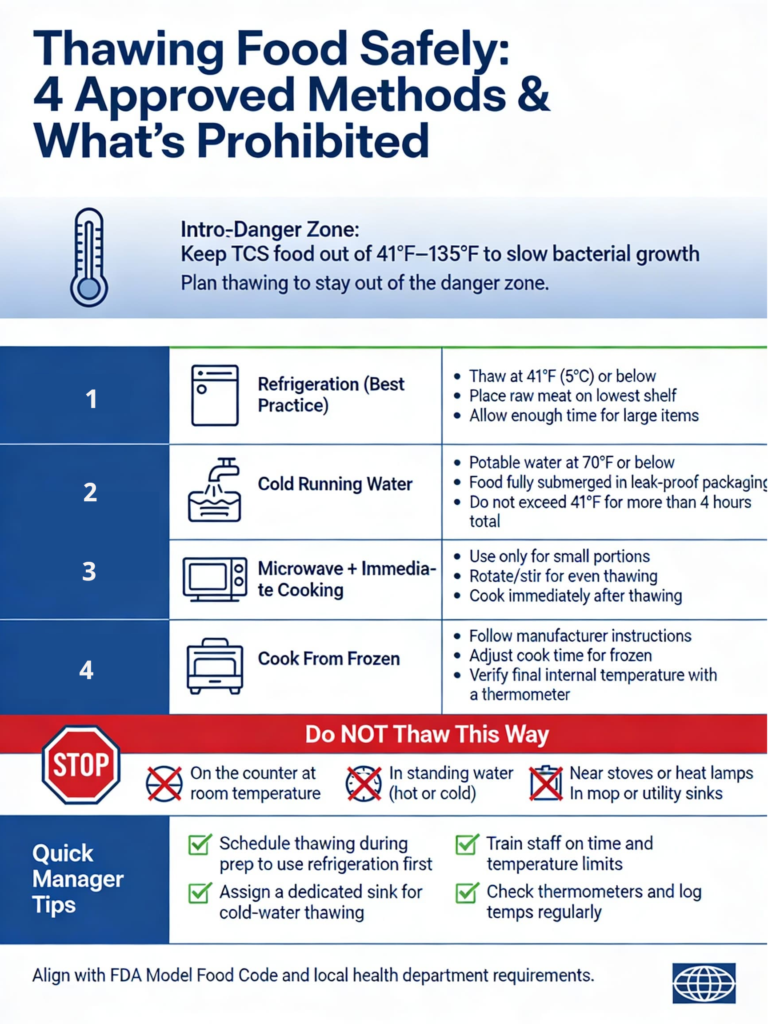
The FDA Model Food Code allows frozen TCS food to be thawed under refrigeration at 41°F (5°C) or less, which keeps the entire product out of the danger zone while ice crystals melt.
- Place raw animal foods on lower shelves to prevent thaw drip from contaminating ready-to-eat items.
- Use trays or pans to contain juices and keep refrigeration units clean and organized. [web:7]
- Plan ahead so large items such as turkeys and roasts have enough time to thaw completely under refrigeration.
Method 2: Thawing under running cold water
The Food Code permits thawing food completely submerged under running potable water at a temperature of 70°F (21°C) or below, with enough flow to remove loose particles.
During this method, the food must not exceed 41°F for more than four hours in total, including any time during thawing and subsequent preparation before final cooking.
- Keep food in leak-proof packaging so water does not enter and contaminate the product. [web:6]
- Use a clean and sanitized food-preparation sink dedicated to thawing while in use. [web:6]
- Position the product so that cold water flows continuously over it rather than allowing it to sit in standing water.
Method 3: Thawing in a microwave oven
The FDA Model Food Code allows thawing in a microwave oven only when the food will be cooked immediately afterward in a conventional oven, microwave, or other approved equipment.
Because microwaves can cause parts of the food to begin cooking while other areas remain frozen, immediate cooking is required so that any portions that briefly enter the danger zone are promptly heated to safe internal temperatures.
- Use the manufacturer’s defrost settings and rotate or stir food frequently to promote even thawing.
- Limit this method to smaller portions that can move quickly from thawing to full cooking.
- Avoid holding microwave-thawed food for later service; proceed directly to the cooking step.
Method 4: Thawing as part of the cooking process
The Food Code also allows cooking food directly from the frozen state as a safe method of thawing, provided the product reaches the required minimum internal temperature throughout.
This approach is commonly used for items such as frozen vegetables, commercially prepared frozen entrées, and products specifically labeled to be cooked from frozen, with cooking times adjusted accordingly.
- Follow manufacturer instructions for time and temperature when cooking from frozen. [web:10]
- Use a calibrated food thermometer to verify that the coldest part of the product reaches the correct internal temperature.
- Avoid using this method for very large cuts where the exterior may overcook before the center becomes safe.
Thawing methods the Food Code prohibits
Just as important as the approved methods are the thawing practices the FDA Model Food Code does not allow, especially those that leave food in the danger zone for extended periods.
- Thawing at room temperature on counters, prep tables, or equipment surfaces, which allows the outer layers to remain between 41°F and 135°F for hours while the center is still frozen.
- Thawing in standing water, hot or cold, where temperatures are not controlled and water is not flowing.
- Thawing near heat sources such as stoves, ovens, or heat lamps that warm the surface of the food too quickly.
- Thawing in non-food sinks such as mop or utility sinks that can introduce physical, chemical, or biological contamination.
Practical tips for managers and food workers
Effective thawing control depends on planning, clear procedures, and training that emphasize both approved techniques and prohibited shortcuts.
- Build thawing into production schedules so refrigeration thawing is used whenever possible.
- Assign specific sinks and equipment for cold-water thawing and train staff on time and temperature limits.
- Incorporate thawing rules into standard operating procedures and food safety training for all food employees.
- Regularly verify refrigeration and water temperatures and use thermometers to check product temperatures during thawing.
By consistently using the four approved thawing methods—refrigeration, running cold water, microwave with immediate cooking, and cooking from frozen—foodservice operations can protect guests, reduce waste, and demonstrate compliance with the FDA Model Food Code.