The Complete Server Training Guide: How Great Service Builds Great Restaurants
The complete server training guide
Guests may forget what they ate — but they will never forget how your server made them feel.
Why Server Training Is the Highest-ROI Investment in Your Restaurant
The most consistently profitable restaurants treat server training as a system, not a side project. Well-trained servers turn first-time visitors into regulars, protect your online reputation, and quietly lift check averages every single shift.
At Food Manager USA, we spend most of our time helping restaurant operators keep the back of the house compliant with ANAB-accredited food manager certification. But operators keep asking us the same question: “What should we actually be training our front-of-house team on?”
So we built a complete server training manual, and this post is the operator’s cliff-notes version. Use it as a shift-meeting reference, a hiring checklist, or the framework for your own in-house program.
The Three Roles Every Server Plays
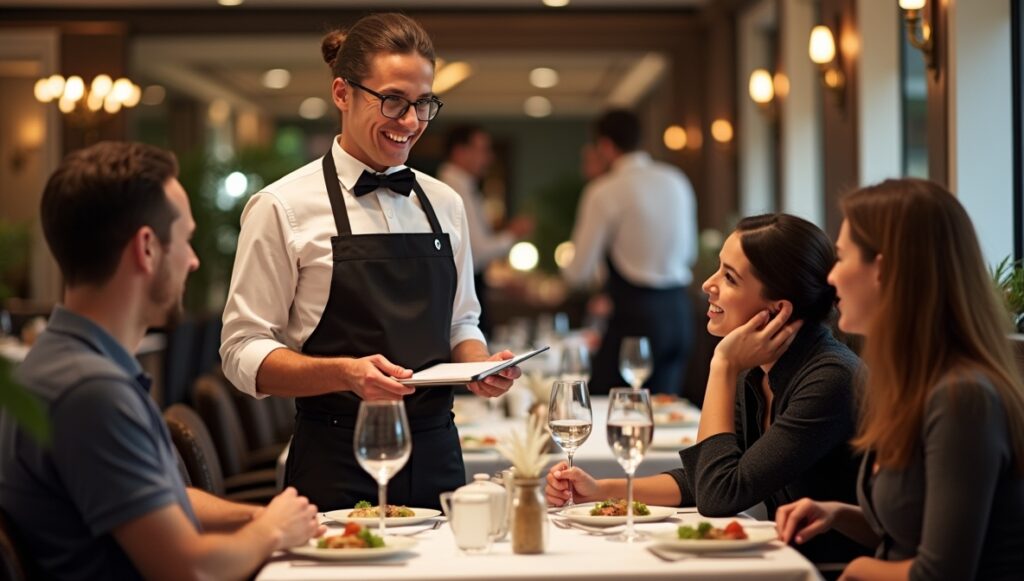
Before a server learns a single procedure, they need to understand their role. Every server carries three identities at the same time:
1. You Are the Experience
Attitude, attentiveness, and problem-solving shape the guest’s entire perception of the restaurant.
2. You Are the Expert
Guests rely on your knowledge of the menu, ingredients, and preparation methods to make confident decisions.
3. You Are the Ambassador
Every interaction represents the brand. Appearance, professionalism, and communication reflect directly on the restaurant’s reputation.
Technical service can be taught. Genuine hospitality comes from a sincere desire to please — and that mindset is what you screen for at the interview and reinforce at every pre-shift.
Our Five-Step Service Philosophy: Look, Smile, Talk, Listen, Thank
Great service isn’t complicated. Distilled to its essentials, it’s five actions repeated at every table:
- Look at me — Make eye contact so the guest feels seen as an individual.
- Smile at me — A genuine smile sets the tone before a single word is spoken.
- Talk to me — Engage with clear, positive, welcoming language.
- Listen to me — Active listening catches the spoken and unspoken cues.
- Thank me — Sincere appreciation at the end leaves a lasting impression that drives return visits.
Print this on the back of every server’s manual. Recite it in every pre-shift. Guests can always tell the difference between obligatory service and genuine hospitality.
Opening Procedures: The Foundation of a Successful Shift
Servers who arrive prepared serve better all night. Our recommended opening cadence:
- 30 minutes before shift — Clock in, uniform check, personal appearance, belongings stowed.
- 25 minutes before — Review the Daily Service Board, reservation details and section assignments, attend pre-shift, taste new specials.
- 15 minutes before — Deep-clean and prep the station: tables, chairs, booths, condiments, napkins, silverware.
- 5 minutes before — Verify POS, confirm tools (pens, wine key), confirm specials knowledge, touch base with the kitchen.
Never let a server rush these steps. Proper preparation prevents almost every avoidable problem during service.
Closing Procedures: Respect for the Next Shift
Closing duties matter just as much as service. A properly closed section signals professionalism and sets up the next crew for success:
- Station breakdown — Sanitize tables, wipe chairs and booths, sweep and spot-mop, refill condiments.
- Restocking — Refill napkin dispensers, restock flatware, prep the coffee station, replenish to-go supplies.
- Sidework — Roll silverware, restock server supplies, assist with general closing duties.
- Financial checkout — Organize receipts, complete paperwork accurately, count banks and tips, review sales with the manager.
The rule we teach: never ask to be cut early before your closing is complete.
Understanding Guests: Four Personality Types Every Server Meets
Every guest is unique, but most fall into recognizable patterns. Teach your team to read the table and adapt:
| Guest Type | Signals | Service Approach |
|---|---|---|
| The Timid Guest | Quiet, hesitant, uncomfortable | Warm smile, light small talk, specific suggestions, unobtrusive check-backs |
| The Aggressive Guest | Demanding, impatient, curt | Stay courteous — never defensive; listen fully; address issues promptly |
| The Fussy Guest | Detail-oriented, many questions | Be meticulous, proactive, double-check every detail |
| The Over-Familiar Guest | Overly friendly, blurs boundaries | Polite but professional, redirect tactfully, keep focus on service |
And don’t forget solo diners — never call attention to a party of one, seat them comfortably, and provide the same attentiveness as any larger table. Solo diners often become the most loyal regulars.
Quality Control: The Server Is the Last Line of Defense
Before any plate hits the table, your server is the final quality checkpoint. Train them to verify:
- Temperature — Hot food hot, cold food cold. Never lukewarm.
- Presentation — Proper portioning, consistent plating, attractive arrangement.
- Serviceware — No chips, cracks, water spots, or food residue on plates, glasses, or silverware.
- Accuracy — Every modification, temperature, and side matches the ticket.
- Accompaniments — Anticipate: ketchup with fries, lemon with fish, extra napkins for messy items.
After delivery, the two-bite rule: check back after two or three bites with a specific question (“How is your steak cooked?”) — not the useless “Is everything okay?”
Menu Knowledge: Expertise That Pays for Itself
A server who knows the menu sells more, handles allergies safely, and builds guest trust. Every team member should be able to:
- Explain ingredients and preparation for every dish, including garnishes and sauces.
- Identify common allergens (nuts, shellfish, gluten, dairy) and understand cross-contamination risk.
- Describe flavor profiles vividly and suggest wine, beer, and side pairings.
- Advise on portions — what’s shareable, what’s a light bite, what’s a full meal.
The golden rule: if a guest asks something you don’t know, never guess. Say, “That’s a great question — let me check with the kitchen.” Honesty builds more trust than a confident wrong answer, and in the case of allergies, it can prevent serious harm.
Where Server Training Meets Food Safety
Your servers handle food, ice, garnishes, and allergen-sensitive orders every shift. Everything they touch sits inside your food safety plan.
In most states, at least one Certified Food Protection Manager (CFPM) is required on staff, and a growing number of jurisdictions require food handler cards for every server, busser, and bartender.
Our ANAB-accredited Food Manager Certification is nationally recognized and satisfies the CFPM requirement in nearly every U.S. jurisdiction.
Putting It All Together
Server training is not a one-day orientation. It’s a rhythm — pre-shift, service, post-shift, weekly menu tastings, monthly refreshers, and quarterly recertifications. Build the system once, and it pays you back every shift for the life of your restaurant.
If this framework was useful, share it with your management team, and reach out if you’d like help building a complete front-of-house training program alongside your food safety compliance plan using this server training guide.
Food Manager USA helps restaurant operators across all 50 states train and certify their teams with ANAB-accredited food manager and food handler courses. Learn more at foodmanagerusa.com.