Massachusetts Choke Saving Procedures Training: What Restaurants Need to Know
A busy dining room in Massachusetts can go from normal to life‑or‑death in a matter of seconds. A guest starts choking, can’t speak, and suddenly every eye in the restaurant is on you and your staff, waiting for someone to act. In that moment, guessing is not an option. You either know what to do, or you don’t.
That’s exactly why Massachusetts has a specific law requiring choke-saving procedures training in many food service establishments. The state wants to make sure that when choking happens – and it does – there is someone on‑site who has been trained in approved techniques like the Heimlich Maneuver and the sequence of obstructed airway maneuvers. In this post, we’ll explain what the law says, which restaurants are covered, and how your team can complete the required training online.
What Does Massachusetts Law Require?
Massachusetts law 105 CMR 590.009(E), along with M.G.L. c. 94, Section 305D, spells out the state’s choke saving requirement. In plain language, it says that every food service establishment in Massachusetts with a seating capacity of 25 or more on the premises must have an employee on site who is trained in approved manual choke saving procedures while food is being served.
The regulation specifically states that at least one employee must be trained in manual procedures approved by the Massachusetts Department of Public Health to remove food lodged in a person’s throat. The Department has designated the Heimlich Maneuver and a sequence of obstructed airway maneuvers as the approved methods for these situations.
In addition, the law requires establishments to make adequate provisions for insurance to cover employees who are trained in rendering this type of assistance. The focus is clear: restaurants with 25 or more seats need to be prepared to respond to choking emergencies, and the state expects them to have at least one trained person present whenever food is served.
Which Establishments Need Choke Saving Certification?
The choke saving requirement applies to Massachusetts food service establishments with a seating capacity of 25 or more. That includes a wide range of operations, such as:
- Full‑service restaurants and diners with 25+ seats
- Hotel and resort dining rooms with 25+ seats
- Bars and lounges that serve food and meet the seat threshold
- Cafés and bistros with sit‑down seating for 25 or more guests
- Other on‑premises food service operations that meet or exceed 25 seats
Local health departments and town boards of health across Massachusetts regularly remind operators of this rule and may check for proof of choke saving training during permit applications, inspections, or routine compliance reviews. If your seating capacity is close to 25, it’s wise to verify with your local authorities and consider training anyway; choking can happen in any size establishment.
Even for smaller establishments with fewer than 25 seats, having staff trained in choke saving procedures is a smart safety measure. The law focuses on 25+ seat operations, but the reality is that choking can occur in any dining room, at any time.
What Are “Approved Manual Choke Saving Solutions”?
The Massachusetts Department of Public Health has issued regulations under 105 CMR 605.000 that designate safe and effective manual procedures for removing food lodged in a person’s throat. These are referred to as “Approved Manual Choke Saving Procedures.” The Department specifically recognizes the Heimlich Maneuver and a sequence of obstructed airway maneuvers as the approved techniques.
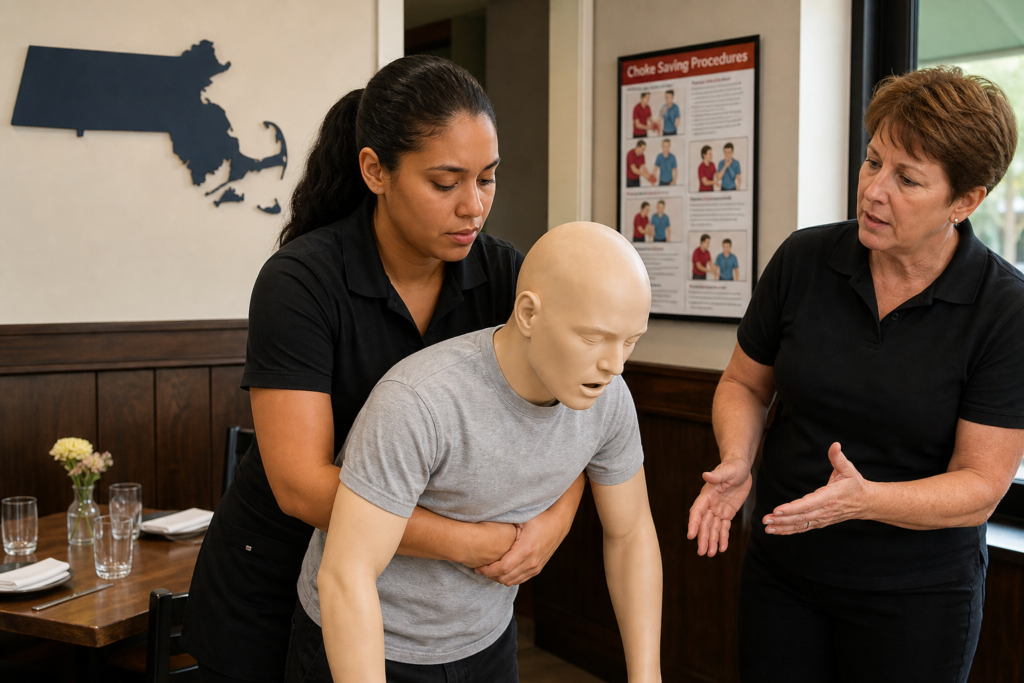
In practice, this training teaches staff how to recognize when someone is truly choking (unable to cough, speak, or breathe) and what sequence of actions to take. That includes encouraging the person to cough if they can, calling for emergency medical services when appropriate, and performing back blows and abdominal thrusts using the Heimlich Maneuver when indicated, according to the approved sequence.
Because these procedures involve hands‑on contact and potentially strong abdominal thrusts, proper instruction is critical. The goal is to apply the right technique at the right time to dislodge the obstruction and restore breathing as quickly as possible, while minimizing the risk of unnecessary harm.
Why Choke Saving Training Matters for Your Business
Choking is one of those emergencies that most people don’t think about until it happens. Yet it can occur in any restaurant, at any time – a piece of steak, a chunk of bread, a large bite of food that goes down the wrong way. In those moments, having someone on your team who is trained and confident can mean the difference between life and death.
From a business standpoint, choke saving training is about more than regulatory compliance. It’s about guest safety, staff confidence, and protecting your reputation. When an emergency happens and your team responds quickly and effectively, you show your guests, your staff, and your community that you take safety seriously. On the other hand, being unprepared can lead to tragic outcomes, shaken staff, and serious questions from regulators and the public.
By investing in choke saving procedures training, you give your staff a clear plan of action. They learn how to recognize choking, how to act quickly, when to call for help, and how to perform the Heimlich Maneuver and related techniques properly. That kind of preparation can save lives and reduce panic when seconds count.
How Our Massachusetts Choke Saving Online Course Works
Our Massachusetts Choke Saving Procedures online course is designed to help your establishment meet the state requirement and prepare your staff to respond effectively to choking emergencies. The training uses expert‑developed content delivered through an online platform, so your staff can complete it from any location with internet access.
Step 1: Enroll in the Course
You or your employees visit our Massachusetts Choke Saving Procedures course page and enroll online. Registration only takes a few minutes, and once it’s complete, learners receive immediate access to the training materials. There’s no need to schedule an in‑person class or wait for a specific date.
Step 2: Complete the Online Training Modules
The course is divided into easy‑to‑follow modules that explain how choking happens, how to recognize it, and how to respond. It covers the approved manual choke saving procedures designated by the Massachusetts Department of Public Health, including the Heimlich Maneuver and the sequence of obstructed airway maneuvers. Visuals and clear explanations help learners understand each step of the process.
Because the training is online and self‑paced, employees can complete it during slower periods or at times that fit your operation, without disrupting service. They can pause and resume as needed until they finish all required sections.
Step 3: Pass the Knowledge Assessment
After completing the training modules, learners take a knowledge assessment to confirm they understand the key concepts. The assessment covers topics like recognizing choking versus mild distress, the correct sequence of actions, and how to perform manual procedures safely. A passing score shows that the learner is prepared to act if a choking emergency happens on the job.
Step 4: Receive a Certificate of Completion
Once the learner passes the assessment, they receive a certificate of completion for the Massachusetts Choke Saving Procedures course. You can print and file this certificate at your establishment as documentation that you have trained staff in the required procedures. This proof can be valuable during inspections or when renewing permits.
The certificate helps demonstrate that you are complying with 105 CMR 590.009(E) by maintaining at least one employee trained in approved manual choke saving procedures on the premises while food is being served.
Make Choke Saving Training Part of Your Safety Plan
Choking emergencies are rare, but when they happen, they happen fast. By making choke saving procedures training part of your safety plan, you do more than just meet a Massachusetts requirement – you give your staff the tools and confidence to step in and help when a guest needs them most.
Instead of waiting until an inspector asks about choke saving training or until an incident forces the issue, you can handle it now and know that you’re prepared. One trained employee on every shift can make all the difference in an emergency.
Get Massachusetts Choke Saving Procedures Training Online
Click the button to enroll in our Massachusetts Choke Saving Procedures online course and make sure your restaurant has trained staff ready to respond if a guest begins to choke.